The dream began on a windkissed quay in a small Cornish fishing village, the seas salty breath warm against the faces of the men hauling their nets. It was August of the previous year, and the sunstill bright, still endlessskittered across the water like a restless child. The harbour was exactly as any other: weatherworn planks groaning underfoot, ropes sighing as they were pulled taut, the everpresent perfume of kelp and brine.
Day after day the routine unfolded in a rhythm that felt almost prayerfulsorting the catch, mending the nets, swapping stories about weather and luck. Nothing hinted that anything extraordinary would break the monotony.
Then, from the deep, a ripple of wonder rose.
A sudden splash shattered the quiet; something slick and swift burst from the surf and ricocheted over the boards. All heads snapped up. There, on the pier, stood an ottermale, drenched, trembling, eyes wide with panic and pleading. He did not bolt, did not hide as wild creatures might; instead he darted among the fishermen, nudging a leg here, a boot there, his voice a thin, childlike whimper before he vanished back to the piers edge.
What in blazes? muttered a deckhand, halfdropping a coil of rope.
Leave him be; hell wander off on his own, another replied.
But the otter did not wander. He begged.
An old fisherman named Arthur, his face etched with the deep lines of sun and salt, felt something ancient flicker behind his eyesa memory of a time when man and nature spoke the same language.
Hold on a moment, he whispered, halfto himself. He wants us to follow.
He stepped toward the gale. The otter bolted ahead, glancing back as if to make sure they were keeping pace.
And then Arthur saw it.
Entangled in the snarled chaos of old nets, seaweed fragments, and broken ropes lay a female otter. Her paws were clenched tight, her tail thrashed uselessly against the surface, each movement only tightening the trap. Beside her, a tiny fluffball clung to its mother, a newborn cloud of fur that could not comprehend the danger, only feel the looming shadow of death.
The male otter, the one who had summoned them, stood at the edge of the planks, watching. He made no sound, made no rush. In his steady gaze lay more humanity than many humans possessed.
Quickly! Arthur shouted. Shes caught in the net!
The men surged forward. One leapt into his boat, another began cutting the ropes. The air was thick with tension, broken only by the otters strained breaths and the slap of waves against the hull.
Minutes stretched into what felt like hours.
When they finally freed the female, she teetered on the brink of collapseher body shivered, her paws barely moving. The newborn nestled against her, and she nuzzled it weakly.
Throw them back! someone cried. Into the seanow!
With great care they slipped the pair into the water. In that instantmother and pupdisappeared into the deep. The male otter, who had watched in silence, dove after them.
All stood rooted, breathless, as if they had just emerged from battle. No words passed; only the sound of their own hearts.
And then, after a few moments, the water stirred again.
He returned.
Alone.
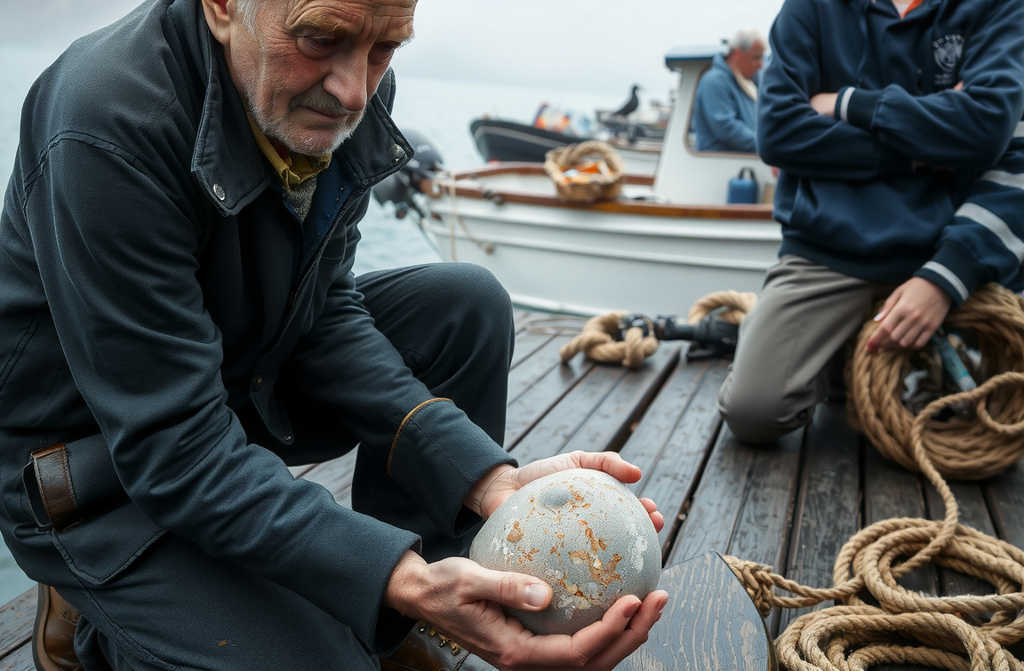
He emerged at the piers edge, eyes still fixed on the fishermen, then, with a slow, deliberate effort, he dragged a stone from between his forepaws. It was grey, smooth, a little wornits surface marked by time and countless uses, a cherished talisman. He set it on the plank where he had first begged for aid, and then slipped back into the mist.
Silence settled like fresh snow. The wind seemed to hold its breath.
He he left this for us a stone? whispered a boy, barely more than a child, his voice trembling.
Arthur knelt, lifted the stone. It was cold, heavynot because of its weight, but because of what it bore.
Yes, he murmured, his voice shaking. He gave us his most precious thing. To an otter, that stone is a heart, a weapon, a toy, a memoryall at once. It travels with him all his life. Every otter finds its own stone and never parts with it. He does not break shells with it he loves it. He sleeps with it, plays with it, shows it to his kits. It is his family. It is his life.
And he gave it to us.
Tears streamed down Arthurs weatherlined cheeks. He did not hide them; no one did. In that shared sorrow they all understood: gratitude had been offerednot with a bark, not with a wag of tail, not with a grand gesture, but with the most valuable thing an otter possesses, given as a man might hand over his last coat to save a stranger.
A handheld camera captured the moment in a spare twentysecond clip, yet those seconds rippled through the world, touching millions of hearts.
Comments poured in:
I wept like a child.
Now I cant see animals as machines.
Yesterday I was angry at my neighbours noise the otter gave everything for love.
Later, scientists declared otters among the most emotional of creaturescrying when they lose their young, clinging together to avoid drifting apart, playing not out of hunger but pure joy. They have souls.
But in that stone, resting on the weathered board, there was more than a soul. There was pure, unselfish gratitudesomething so rare it seemed almost mythic.
Arthur still keeps that stone on a shelf beside a photograph of his late wife, who passed five years ago. He says that when the house falls quiet, he looks at it and thinks, Perhaps we could learn something from the animals?
In a world where selfishness hides like a cave, a tiny otter showed that love and thankfulness outweigh even the strongest instinct.
The heart is not in the chest; it lives in actions.
And the stone? It is a memory.
It tells us that even in the wild, in the deepest sea, there is something beyond mere survival.
It lives in the heart.
If you have a moment, like, share this tale. Perhaps someone who reads it will pause, see the world anew. The stray dog becomes a companion, the sparrow on a branch becomes a song, the animal becomes a sibling.
And maybe one day well leave not litter on the shore, but something truly valuable
A stone.
A heart.
A love.