I am fiftyeight. While Im waiting at the checkout I recognise a woman who once stole my husband, and I finally see what my own happiness has cost me.
At first, its not her face I notice but her handsthin, dry, veins standing out. She places a loaf of bread, a carton of milk, a packet of rice, chicken thighs, cheap cottage cheese and a small chocolate bar on the conveyor belt.
She puts the chocolate bar back in the bag.
The cashier calls out the total. The woman fumbles through her purse, counts the notes, then whispers:
Dont bother with the chocolate.
She turns away, and I realise I know her.
Evelyn.
My husbands first wife.
The very woman I have spent thirty years telling myself, Well, love doesnt ask permission.
Im fiftyeight.
Thirty years ago I was twentyeight, working in a project office, my lips glossy with bright lipstick, convinced that life was just beginning.
David was nine years older than me. He wasnt a covermodel type, but he had a quiet confidence, a way of listening that made you feel you were the only woman in the room.
He was already married.
I knew that from the start.
A wedding ring on his finger. A photograph of his daughter tucked into his wallet. The familiar male excuses: The house has been empty for ages, We live like neighbours, Evelyn never understands me, I stay only for the child.
Now it disgusts me to recall how easily I believed those lines.
Back then it felt like we had a special storynothing dirty, nothing sordid, no runaway. Just two people who were meant to meet.
Evelyn, to me, was never a living person but an obstacle, a character from his anecdotes: the cold wife, the exhausted one, forever dissatisfied, neglectful of herself, unable to grasp the subtle soul of a man who craves warmth.
I had never actually seen her, yet I had already blamed her.
Convenient, wasnt it? If the wife is terrible, then Im not destroying a family. Im somehow rescuing a man.
A year later he leaves me for me.
The scandal was massive, but I only ever heard his version. Evelyn wept, shouted, his daughter locked herself in her room, his mother cursed him over the phone.
He arrived at my flat with two suitcases and the look of a man who has finally chosen a life.
I felt victorious then, though I never said it aloud. Inside, I told myself: he chose me, therefore Im better.
We signed the papers eight months later.
And happiness was real. I wont lie.
We truly loved each other. We drove down to the coast, we renovated the house, we had a son. David worked, brought home money, built a cottage, fixed the car, bought me new boots when the old ones got soaked.
His relationship with his daughter from the first marriage deteriorated. At first he visited on Sundays, then less often, until she stopped answering his calls altogether.
I would say, She just needs time, while deep down I was relieved.
Because Sundays were now ours.
We barely mentioned Evelyn. If we did, it was only in passing.
She keeps asking for money. She tries to manipulate the child. She cant accept that life has moved on.
I nodded. It was easy to think of Evelyn as merely a spiteful exwife. If shes spiteful, Im blameless.
Thirty years have passed.
David died two years agoheart attack, sudden, at home, early morning. I still sometimes set two mugs on the kitchen table and then remove one.
Our son is an adult, living on his own. I have a flat, a cottage, a modest pension and a parttime job. Not luxurious, but a decent life.
The same life David and I built together.
One ordinary afternoon I pop into the local supermarket for milk and I see Evelyn at the checkout.
She looks much older, even though were almost the same age. Her wear isnt from years but from a longstanding fatigue that has settled into her shoulders, her gait, her eyes.
She puts the chocolate bar back, grabs her bag and is about to walk away.
I want to turn my back.
Honestly.
Pretend I dont know her. Walk out. Forget.
But she looks up at me and recognises me instantly.
Good afternoon, Marilyn, she says.
Im startled.
Good afternoon, I manage.
We stand by the exit while shoppers weave past us with trolleys, a boy begs his mother for a chewing gum, someone curses at the ATM.
I stare at the woman whose life I once split in two and I dont know what anyone says in a moment like this.
How are you? is the only question I can think of.
She offers a faint smile.
Im getting on, she says, then mentions that she heard about Davids death from his daughter.
His daughter.
The same girl who once shut herself in a bedroom when her father left with suitcases.
I ask how she is doing.
Evelyn looks at me carefully.
Do you really want to know? she asks.
I dont answer.
She tells me her daughter has been disabled since a car accident years ago, can barely walk, cant work properly, and they live together.
I didnt know that.
David never mentioned it. Or perhaps I never listened. Or maybe I never asked in a way that would have let it surface.
I offer to give Evelyn a lift.
Im not sure whymaybe to smooth something over, maybe because for once I want to feel less like a victor and more like just a person.
She first declines, then agrees, weary as she is.
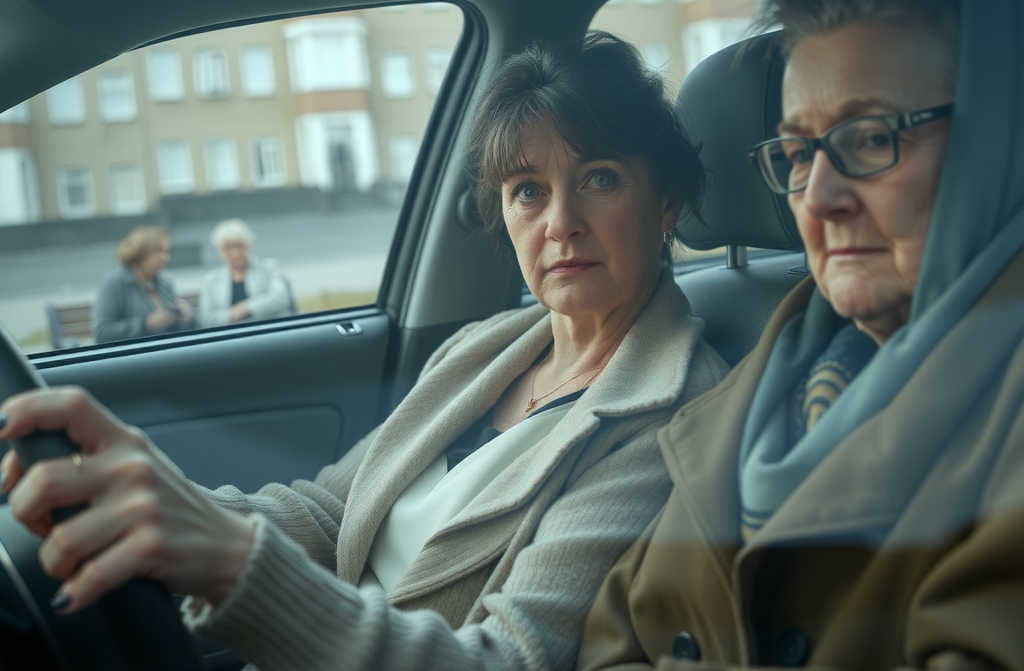
In the car we sit in silence. I steal glances at her clean, worn coat, the tattered bag, her hair pulled back in a knot.
And I remember Davids words from thirty years ago:
She stopped being a woman. Everything became about the house, about demands.
Now I think perhaps she never stopped being a woman. Perhaps she was simply the one who kept the home, the child, the husband who was already looking elsewhere.
I park outside her block of flats: a fivestorey council block, a chipped door, two old ladies chatting on a bench, curtains halfdrawn on the groundfloor windows.
I say, almost without thinking,
Ive often wondered whether I should have talked to you.
Evelyn doesnt turn.
When?
I cant find the words.
I dont know. Then.
She replies calmly,
At that time you didnt want to speak. You wanted to win.
It hits me so precisely that I stay silent.
She opens the door, then closes it again and looks at me.
You know, I hated you for a long time, she says.
I nod.
I understand, I reply.
No, you dont.
She holds the bag with both hands.
You took away not a man, but a normal life, she says.
Those words knock the breath out of me.
I want to arguethat a person cant be taken if they dont want to be, that he was an adult and left of his own accord, that if the marriage had been happy he wouldnt have left.
I have recited those defenses for thirty years.
But sitting opposite a woman who just put a chocolate bar back because she cant afford it, my rehearsed lines feel pitiful.
Evelyn speaks calmly, without raising her voice, and that makes it hurt even more.
She tells me how, after Davids stroke, she cared for his mother, shuttled her daughter to doctors, worked two shifts, while he came home smelling of my perfume, expecting her to stay lighthearted and understanding.
When he left, she was thirtynot an old woman, not a monster, just a mother with a child, a mortgage, a sick motherinlaw that he also abandoned for half a year while we built a new life.
I whisper, I didnt know.
She snaps, And you wanted to know?
I say nothing.
Because I didnt want to.
I needed a version where love triumphs over circumstance, where Im blameless, where the first wife ruined everything herself, where the man ran away not out of responsibility but for happiness.
Evelyn gets out of the car. I follow, still unsure why.
Evelyn, Im sorry, I say.
She looks weary,
No, you dont have to.
Why? I press.
Because its what you need now, not me.
I stand there with my keys, like a schoolgirl before a stern headmistress.
She lowers her voice,
Ive survived as best I could. I raised my daughter, looked after his mother. Can you imagine? She kept calling me stepdaughter until the end. He came once a month with money and guilty eyes, then less often.
David used to tell me he was helping.
I never asked how much.
He said dealing with the daughter was hard; she was set against him.
I never asked why.
He said Evelyn was strong, shed manage.
I believed him.
Because if she could manage, then I could be happy without her pain.
Outside the block, Evelyn pauses and says,
Youre not the only one at fault, Marilyn. He was more, but you werent blind. You just didnt look.
She steps into the stairwell.
I sit in the car for twenty minutes, then drive home and, for the first time in many years, look at my life not as a romantic saga but as a house partly built from other peoples wreckage.
Everything in the house is the same.
My kitchen, my curtains, a photograph of David on the shelfsuntanned, smiling, holding a fishing rod.
I used to stare at that picture and think: my husband, my love, my destiny.
Now I stare and think: how many people paid the price for him to become mine?
That evening my son calls.
Hey Mum, how are you?
I almost answer, Fine, but I cant.
I tell him I ran into Evelyn, that shes struggling, that his sister is disabled.
He sighs,
Mum, why bring this up now? That was a century ago.
A convenient phrase.
Hundred years ago feels like it makes the pain less sharp, as if its no longer painful.
For her it isnt, I say.
He falls silent.
Since that day I begin to recall the things I used to skirt around.
How David delayed child support, then bought me a new coat. How we drove to the seaside while he said his daughter didnt need a holiday. How I snapped when Evelyn called at night. How once I said,
Maybe stop paying her extra beyond the maintenance? We have a child too.
He looked at me oddly then, but said nothing.
Now Im ashamednot the kind of shame that spurs improvement, but a sticky, late, useless shame.
I cant give Evelyn her youth back. I cant reunite her daughter with her father. I cant restore an honest version of my happiness.
All I can do is stop lying, at least now.
A week later I find Evelyns number. I stare at my phone, then type:
Evelyn, Im not asking for forgiveness again. Youre right, it would mean something to me. But if your daughter needs help with doctors or medication, Im willing to helpno strings attached.
She replies the next day,
Ill think about it.
And thats it.
She may never write again. She may be right.
I have no right to step into her life with charity as if it could fix anything. And I cant pretend nothing ever happened.
The strangest part of all this is that I did love David, genuinely.
I cant claim our life was a lie. There was tenderness. There was a son. There were good years. There were evenings when he held my hand and I felt happy.
But now, beside that happiness, there will always be another woman at the checkout, putting a chocolate bar back because she cant afford it.
And I cant take her away.
Perhaps this is the late payment.
Not that someone takes something from you, but that at last youre shown the full price of what you once took.
Tell me honestly: if a woman stole a married man decades ago and built a happy life with him, does she have the right, years later, to ask forgiveness from the woman whose life she shattered? Or is the later remorse meant only for the one who spent too long calling anothers pain her own destiny?